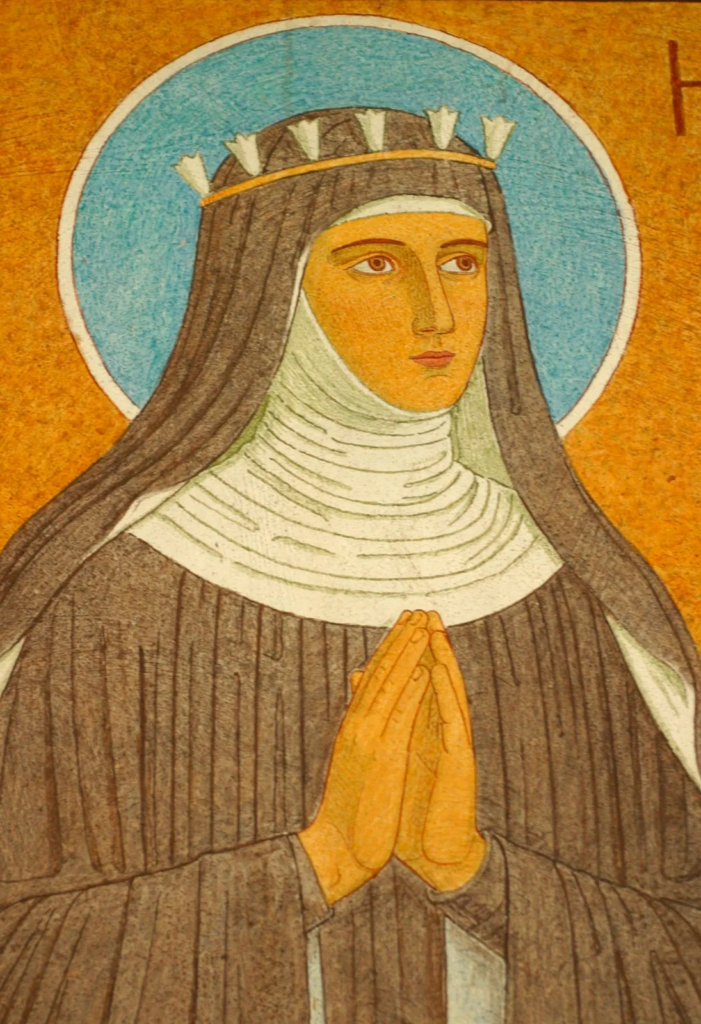
[Image credit: Brittanica]
Hildegard of Bingen was an innovative composer, theologian, visionary, and healer. Her pioneering and inventive contributions to music, religion, and medicine make her an enduring figure today. Her music remains relevant in spiritual and musical settings. At the heart of her work is an understanding of music as a tool for healing, devotion, and spiritual transcendence. This is why I chose Hildegard of Bingen as an excellent example of an artist who combines music and ‘spiritual healing.’
First, I’ll talk about her music ~
Hildegard is renowned as one of the most famous composers of plainchant, creating 77 monophonic songs and the morality play, Ordo Virtutum (Play of the Virtues). Her compositions span antiphons (chants sung before or after psalms), responsories (musical postludes after a sermon), sequences (poetic and musical additions to liturgy), and hymns (religious song to praise God) showcasing her versatility and creativity in religious music despite a formal education. She is known for sacred monophony, such as Gregorian chants or plainchant, which is defined by a single melody without any accompaniment.1
Her piece below, “De Spiritu Sancto,” praises the lord for creating life, and it is accompanied by medieval-era instruments (Hurdy-Gurdy, Tempura, Fidel, Gothic Harp, and Recorder).
Her music is characterized by soaring, embellished, and ethereal melodies that transcend the boundaries of traditional Gregorian chant. While she was faithful to traditional music theory, she also had a unique musical style. This distinctive style, paired with profound theological and poetic depth, reflected her visionary experiences, which she described as messages from God. Her role as a visionary leader established credibility for her musical compositions, especially at a time when women were not encouraged to compose. For Hildegard, music was not only a form of artistic expression but also a vehicle to explore and articulate the messages from the divine. Music was the highest form of human expression. Religion, healing, and music often triangulate, and Hildegard of Bingen was skilled in all of those areas.
Symphonia – a chant repertoire
“Symphonia is a key concept in Hildegard’s
Matthew hoch2
thought… It designates not only a harmony of diverse notes produced by human voices and instruments, but also the celestial harmony, and the harmony within a human being. The
human soul, according to Hildegard, is “symphonic” (symphonialis), and it is this characteristic
that expresses itself both in the inner accord of
soul and body and in human music-making.”
She believed in dynamic interconnectedness of the spirit, mind, and body. She also viewed music as integral to the connection between body and soul. Her religious compositions were intended to rejuvenate and strengthen the spiritual community. As head of the church community, she was in charge of ensuring the spiritual well-being of the nuns. The nuns in her abbey found sustenance in singing her chants, which required expansive breathing and brought about meditative states. Her compositions emphasize that singing praises to God was a way to achieve emotional and spiritual healing. 3
Hildegard also believed that music had therapeutic effects, softening hardened hearts and serving as an emotional force for healing.4
She believed music was the main form of communication with God and was a representation of angel voices and Adam’s voice before ‘original sin.’ In the Causae et curae, a book she wrote on natural treatments to disease, she writes, “Before his transgression Adam knew angelic song and every kind of music, and he had a voice that sounded like the voice of the monochord.”5 A monochord is a stringed instrument, but with only one string. This description aligns with her broader theological framework, where music is a reminder of humanity’s lost harmony with God, and it is a tool for spiritual restoration. With Adam’s voice resembling a monochord, she emphasizes his simplicity and purity that was disrupted by original sin. It also reflects that music is more than artistic expression; it is a healing force that connects the soul to God.
Here is an online version of Causae et curae if you are curious [but it is in Latin, so it would be difficult to read unless you know Latin]: https://archive.org/details/hildegardiscaus00hildgoog/page/n18/mode/2up
In the documentary A Very Real Mystic, theologian Matthew Fox highlights the physical effects of Hildegard’s music. Singing her compositions demands significant breath control, leading to feelings of lightheadedness or euphoria—a testament to the healing and meditative qualities of her work.6 This physical response reinforces that music is a spiritual gift meant to unity the body and soul, as the act of singing is an embodied form of prayer and meditation.
Hildegard von Bingen: Selections from Symphonia armonie celestium revelationum
Her work as physician
Hildegard was also deeply involved in the realm of medicine, writing two medical texts [Physica and Causa e cure] based on her understanding of natural remedies and scripture. These texts, along with her practice of treating diseases in her community, reflect her holistic approach to wellness. Her belief in balance—spiritual, physical, and emotional—was revolutionary for her time and remains relevant today.
Hildegard’s music serves as a bridge between the earthly and the divine, embodying her mystical theology. As noted by New Eden Ministry, her compositions express the “profoundly ineffable,” drawing listeners into a transcendent experience.7
Her legacy continues in performances like those by sound healer Norma Gentile, whose concerts integrate Hildegard’s chants with Tibetan singing bowls and spoken blessings. She also does private healing lessons for chronic issues and performs healing concerts and sound healing workshops. These involve Tibetan Singing Bowls and Harmonic Toning. This modern reinterpretation highlights the timelessness of Hildegard’s music, demonstrating its ability to inspire meditation, creativity, and healing across centuries.8
Hildegard’s life and work exemplify the seamless integration of religion, music, and healing. Her chants were acts of devotion that strengthened spiritual bonds. Her theological writings and visions offered profound insights into divine mysteries. And her medical practices provided lasting care to her community.
Hildegard of Bingen is a pioneer whose vision and creativity resonate deeply with modern understandings of music’s therapeutic power. Her work reminds us of the enduring connection between music and spiritual well-being.
- Morent, Stefan. “Hildegard of Bingen on Music” https://bartholomew.stanford.edu/onmusichildegard/intro.html ↩︎
- Hoch, Matthew. “The Music of Hildegard von Bingen: A Categorical Overview of Her Complete Oeuvre.” May 2020. ↩︎
- Campbell, Nathaniel M. Lomer, Beverly R. Sandstrom-McGuire, Xenia. “The Symphonia and Ordo Virtutum of Hildegard von Bingen”
https://www.hildegard-society.org/p/music.html ↩︎ - Morent, Stefan. “Hildegard of Bingen on Music” https://bartholomew.stanford.edu/onmusichildegard/intro.html ↩︎
- Margret Berger, ed. and trans. On Natural Philosophy and Medicine: Selections from Causae et curae. Cambridge: D.S. Brewer, 1999, 3.11 [114a]. ↩︎
- “Hildegard and the Transcendent Power of Music” 2020, April 5. https://newedenministry.com/2020/04/05/transcendance/ ↩︎
- Ibid. ↩︎
- Norma Gentile. Healing Chants. https://www.healingchants.com/
↩︎