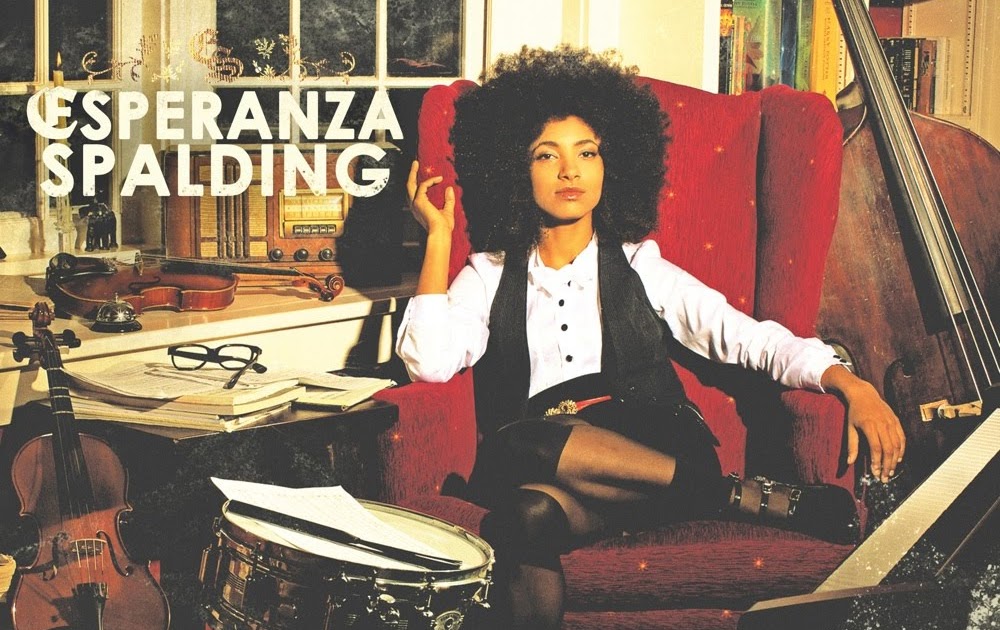
[Image credit: Chamber Music Society Album Cover]
Esperanza Spalding: Bassist. Singer. Songwriter. Composer. Five-time Grammy-winning jazz musician and previous Harvard professor.
She broke new ground in 2011 as the first jazz artist to win the Grammy for Best New Artist. She also expanded the boundaries of music through her refreshing and revitalizing blend of jazz artistry, academic inquiry, and wellness. With her 2021 album Songwrights Apothecary Lab, Spalding directly experiments with the therapeutic value of music, demonstrating how making and listening to music can heal the body, mind, and spirit. The New York Times describes the album as a retreat into wellness, emphasizing Spalding’s holistic approach.1
Songwrights Apothecary Lab (S.A.L.) “seeks to respectfully dip into the healing seas of music/musicianship/song, and distill a few grains of piquancy which carry the life-renewing flavor of the unfathomable ocean of human resiliency, then work those grains into new musical formwelas”
– Esperanza Spalding on the S.A.L. album description.2
Songwrights Apothecary Lab, released on September 24, 2021, combines music and wellness with an experimental framework that Spalding describes as “half songwriting workshop and half guided-research practice.” It was released by Concord Records. It debuted at number 11 on the US Billboard Contemporary Jazz Albums. At the 64th Annual Grammy Awards, the album won Best Jazz Vocal Album. This project emerged from her interest in the therapeutic powers of music, guided with collaborations with music therapists and neuroscientists.
The album’s 12 tracks, or “formwelas,” each serve a distinct therapeutic purpose, similar to prescriptions tailored for emotional and physical well-being. It was released during the pandemic, which was likely a response to the high levels of stress and loneliness many felt.
Esperanza writes on the album description:
“All Formwelas (songs) from the S.A.L. are created through our research, divination, intuition, musicianship, taste, inspiration, and collaborative effort to design songs that enhance a specific salutary affect”
– Esperanza Spalding on S.A.L Album description.2
Esperanza clarifies that the formwelas are not potential “solutions”. Rather, they are responses to the issues facing the artists and creators in Songwrights Apothecary Lab.”3
In crafting the concept, Spalding likens songwriters to apothecaries, blending ingredients, or musical elements, into compositions that address specific needs. “An apothecary is somebody who puts together different ingredients,” Spalding explains, “and the concoctions are composed, brewed, offered for the specific needs of a person.” 3 The result is a deeply exploratory and collaborative approach to music-making that integrates science, spirituality, and creativity.
This aligns with Spalding’s belief that “music fuses the mystical and physical planes” 3 Music plays a large role in spirituality, and connecting with the divine, and healing plays a large role in that.
Each formwela has a therapeutic effect and is inspired from her conversations with music therapists and neuroscientists.
Spalding’s exploration of music as a way of healing builds on her lifelong relationship with music. She recalls, “As a child, I learned that music could be a nurturing, healing thing.”4 This philosophy is evident in her earlier works, such as 12 Little Spells (2018), where each song corresponds to a different body part, creating what Spalding called “spell songs” for physical and emotional engagement.
Her approach also reflects the influence of jazz legend John Coltrane, who famously expressed his desire for music to heal: “If one of my friends is ill, I’d like to play a certain song and he will be cured.” She listed this quote on the Songwrights Apothecary Lab album description. And she responded to the quote with: “Us too.”
Like Coltrane, Spalding is driven by the belief that music has the power to transform and nurture human resilience.
The therapeutic quality of Spalding’s Songwrights Apothecary Lab lies in its intention and execution. Spalding intentionally uses music to heal. To do so, she collaborated with a range of experts, including neuroscientists, therapists, and fellow musicians, to design pieces that resonate with the body’s innate healing processes.
Tracks like Formwela 1 and Formwela 3 are imbued with calming melodies and rhythms aimed at fostering relaxation and grounding the listener. For example, Formwela 3 is designed to help listeners center themselves after navigating challenging dynamics, reducing anxiety and tension in both mind and body. This aligns with findings in neuroscience that show how calming music can synchronize with brain activity and promote meditative states.5
Spalding’s experimentation with wellness and music on Songwrights Apothecary Lab is her latest chapter in a career defined by innovative music. From her early albums like Junjo (2006) and Esperanza (2008) to her Grammy-winning Radio Music Society (2012), she has continually pushed the boundaries of jazz and music.
Beyond music, Spalding has sought to understand the intersection of sound, body, and mind through initiatives like retreats where artists can create music away from the noise of the real world.6
Spalding’s work directly shows the power of music to heal and connect. Through projects like Songwrights Apothecary Lab, she reimagines the role of musicians as not just entertainers but as healers and experimenters. Music is also a response to the issues of the real world, and this Songwrights Apothecary Lab is a demonstration of how music can be used to heal.
When she took a semester off from teaching at Harvard, she wrote an opera, called Iphigenia, with multi-reedist and composer, Wayne Shorter. She noted that despite his ailing health, he sprung “back to life” when making music. 7
In addition, during her time off, she created TRIANGLE, which is part of the Songwrights Apothecary Lab. TRIANGLE includes “Formwela 1,” “Formwela 2,” and “Formwela 3.” The pandemic inspired her to create these songs because it might alleviate the feelings of isolation.7
Formwela 1: Starts with a meditative chant. Esperanza’s soothing voice tells us to ground ourselves (“Sink into the ground”). There are nature noises, such as thunder, and birds chirping. This piece seeks to remind us to center ourselves and find the beauty in nature and our surroundings, even during moments of stress.
Formwela 2: It also starts off with a meditative chant. There are instruments associated with nature, such as a conch shell. This piece was inspired by her collaboration with multi-instrumentalist Ganavya Doraiswamy, and the philosophy of Harikatha, which is a form of storytelling in parts of India.
Formwela 3: The lyrics refer back to being isolated during the pandemic: “Wither, wither if we don’t find sunlight somewhere soon/
How am I to be, to be at home with all this density embodied/
Everybody’s density up on me, ah.”
The ending of the piece repeats these mantras: “While we are stuck inside/
Wide atmospheres breathe and surround you, ah”
This piece was very hopeful and uplifting at the end, with the potential to get the listener to move and breathe along with the music. The album description says that this formwela seeks to release the “heaviness of a seemingly endless blue state.”
“Formwela” descriptions according to the S.A.L. album:
Formwela 4: “the articulation of needs streaming oxygenation through your ancestral vessel/vein of infinite life
For tuning oneself to expect and receive attunement when speaking intimately to the heart’s un-articulated needs. Use to remind oneself that loving and self-giving are not individual undertakings; that even in the most intimate circumstances, ancestors and earth’s support forces are in attendance, for the honoring of their beauty via the truth of how you really are, and what you really need.”Formwela 5: “filial veneration penetrating the massive heart nerve deep within the hard-shelled mind-body of a male sibling’s protective, enduring, and searingly luminous survival style
For transmitting to your older brother, -who has survived by means you don’t understand- the register of your love, and recognition of the profound gift he is to the world you both bore into.”Formwela 6: “the scrambling vulnerability after overly-cryptic confessions of heart-scarring, slackens into synch with another’s tender relational orbit
For steadying the vast-spinning “potential hurt” analysis triggered by the bliss of new romance. Invites the memories of past burns to passively collaborate in the charting of orbital alignments more conducive to channeling the flow of self through intimacy.”Formwela 7: “a sense of permission to close one’s eyes, and allow others to perceive that the listening faculty is fatigued.
Use to gently, -then if needed less gently, -then if that doesn’t work…quite fumingly- stop, slow, shift-the-track-of, and/or remove-oneself-from-the-path-of a drawn out talking train that’s become unscrupulously long, and singularly driven by a speaker un-noticing of diminishing conversational mutuality, and/or the listener(s)’ fatigue.”
Formwela 8: “a sound at ease, with no urge to move from that comfort place*.
For dissolving anxiety-induced tactics of self-regulation, into the dynamic buoyancy of a secure, comfy, and sane home-place. Use to support a sense of the one’s spirit being embraced and nursed to its fill in the bosom of a nurturing and constant connection.*formwelated by Leo Genovese”
Formwela 9: “the seduction beams of an enchanter/x/ress become scrambled in a force field of your-own-homies’-love-for-you surround-swirling to create a calm center for clear re-remembering of your own root of sacredness, cared-for-ness, eros-reservoir, and community.
Use as an amulet of protection to intercept the magnetism and/or seductive pull of someone tryna get high by luring your attention and/or attraction.”Formwela 10: “via a public admission of how aggressive-seducing patterns sullied a clean, clear, purely offered gift of human intimacy, remorse waterizes and returns to source as the outpouring release of inventory-taking rinses and renews the heart
For grieving the consequences of, becoming more alert to, and dissolving one’s own romantic-entitlement tendencies.”Formwela 11: “the perpetual effort to keep up with all the things all the time…- slackens…allowing spaciousness to accompany times’ flow, and the aperture of your receptive presence, to widen.
Use to slow down and remember to make space/time for your elders, amidst the myriad thoughts, people, and things you and others your age are busy busy busy solving, responding-to, interjecting-in, keeping-up-with, pursuing, showing-competency-at, figuring-out, proving-yourself-to, and/or, steadily-remaining-distracted-by, while a pantheon of life experts (elders) are available to illuminate the seconds-to-midnight construction site of your most beautiful dreams.*formwelated by Matthew Stevens”
Formwela 13: “as your smoke-screen of brooding cloudiness releases into the basic-affinity and love of others, the same canal which when empty seemed like an endless valley of hell you had to walk along the bottom of alone, fills into a carrying and supporting river.
Use to release the pretentious illusion that others can’t see through your stingily maintained smoke-screen of dark grandeur, and notice how you are in fact loved because AND despite of your burning, condensated, sullied human-ness.”
[Song descriptions pulled from Songwrights Apothecary Lab Website].
Spalding’s journey is a testament to the idea that music transcends entertainment—it is a vital force for healing, connection, and transformation. With Songwrights Apothecary Lab, she invites us to explore this potential, one formwela at a time.
Albums:
Junjo (2006). Label: Avya Musica.
Esperanza (2008). Label: Heads up International.
Chamber Music Society (2010). Label: Heads up International.
Radio Music Society (2012). –> won the Grammy for Best Jazz Vocal Album. Label: Heads up International.
Emily’s D+Evolution (2016). Label: Concord.
Exposure (2017). Label: Concord.
12 Little Spells (2018). Label: Concord.
Songwrights Apothecary Lab (2021). Label: Concord.
Milton+Esperanza (2024). Label: Concord. [Dedicated to Wayne Shorter, who passed away last year].
Footnotes:
- Russonello, Giovanni. “Esperanza Spalding’s Latest Project: Music Designed to Heal.” The New York Times, April 1, 2021. https://www.nytimes.com/2021/04/01/arts/music/esperanza-spalding-triangle.html.
- Songwrights Apothecary Lab. “About.” Accessed December 8, 2024. https://songwrightsapothecarylab.com/About.
- GRAMMY. “Esperanza Spalding on Her New Album Songwrights Apothecary Lab and the Healing Power of Music.” GRAMMY.com, accessed December 8, 2024. https://www.grammy.com/news/esperanza-spalding-interview-new-album-songwrights-apothecary-lab-music-wellness-research.
- Grow, Kory. “Esperanza Spalding Knows Music Can Heal—Now She Wants to Prove It with Science.” The Daily Beast, April 10, 2021. https://www.thedailybeast.com/esperanza-spalding-knows-music-can-heal-now-she-wants-to-prove-it-with-science/.
- Harmony and Healing. “How Music Can Reduce Stress.” Accessed December 8, 2024. https://www.harmonyandhealing.org/how-music-can-reduce-stress/#:~:text=The%20persistent%20rhythm%20and%20melodic%20patterns%20create,helping%20restore%20balance%20and%20promoting%20overall%20well%2Dbeing.
- Russonello, Giovanni. “Esperanza Spalding’s Latest Project: Music Designed to Heal.” The New York Times, April 1, 2021. https://www.nytimes.com/2021/04/01/arts/music/esperanza-spalding-triangle.html.
- Moreland, Quinn. “Esperanza Spalding: Triangle Album Review.” Pitchfork, May 5, 2021. https://pitchfork.com/reviews/albums/esperanza-spalding-triangle/.